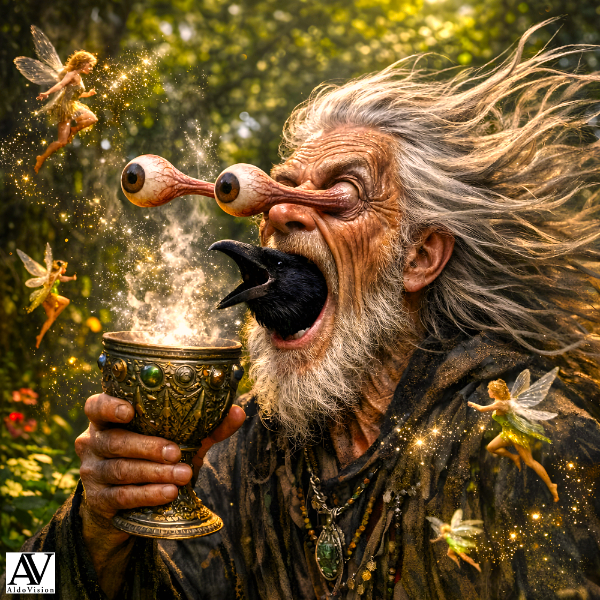
Merlin had warned them twice.
“Not the gold dust,” he had said, lifting the goblet with the solemnity of a king at sacrament. “And absolutely not into my morning tonic.”
Faeries, being faeries, love contraries. They took this as an invitation to improve the wizard’s tonic and sprinkled gold dust liberally.
So now the old wizard stood in the green light of Brocéliande, beard aflutter, hair storm-tossed, eyes stretched monstrously from his head as though trying to escape the consequences before the rest of him could. From his mouth burst not prophecy, not fire, or some Latin of power, but a blackbird – sleek, indignant, and very much alive.
It shot into the air with a cry like a ripped seam.
The faeries scattered in a glittering panic, though not too far. They never fled farther than laughter would carry. One hid behind a foxglove bell. Another clutched her sides and pointed. A third, bolder than the rest, hovered before Merlin’s nose and peered mischievously across the steaming cup.
“Oh,” she said. “That was a mouthful, even for you Merlin!
The wizard fixed her with the most terrible stare a man could manage while still partially cross-eyed. The forest around him listened. Even sunbeams seemed to pause.
“At once,” he growled, “you will reverse this enchantment.”
The faery tilted her head. “Which part, great wizard? The blackbird, the eyes, or your temper?”
Merlin considered, then sighed smoke and feathers.
“The temper,” he said. “The others may prove useful.”